The ALO sodium resonance-fluorescence lidar transmits laser pulses tuned to the sodium D2a line at 589 nm — the same golden-yellow light emitted by low-pressure sodium lamps — and detects the backscattered fluorescence from the naturally occurring sodium layer in the mesosphere and lower thermosphere (MLT) at 80–105 km altitude.
Temperature is retrieved from the Doppler broadening of the sodium absorption line profile. Wind velocity is measured from the Doppler frequency shift of the returned signal: vertical wind from the zenith beam, and horizontal winds from two off-zenith beams. Sodium density profiles are obtained directly from the return signal intensity. Typical resolution is 1 minute and 500 meters, though the achievable resolution depends on signal-to-noise conditions during each night of observation.
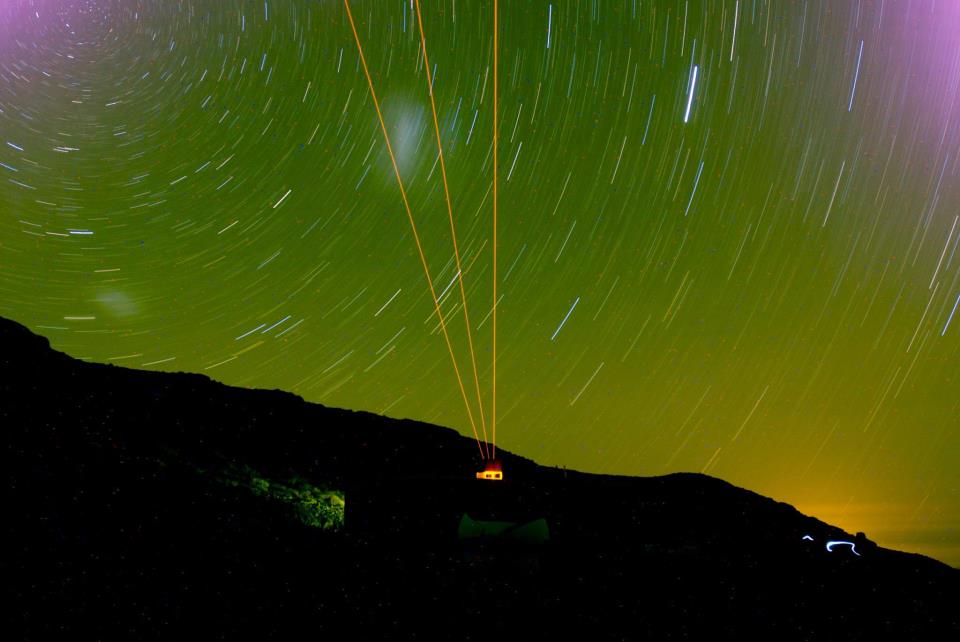 Photo: Fabio Vargas
The Na Lidar is co-located at ALO with the CONDOR meteor radar and an all-sky imager, enabling simultaneous multi-instrument observations of the MLT. The lidar operates in nighttime campaign mode, with observing periods of several nights per month, recurring across multiple months within a year. The dataset covers 23 campaigns across 2014–2023, totaling over 2,400 observing hours.


